On this page:

News

Newsletters

The Journal, Volume 44

To see the list of contents of the current issue of the MIAS Journal, see the Journals page.


News articles

Cairo symposium lectures go online

International Congress Ibn ‘Arabî in Egypt Crossroads of East and West - first session.
Gamal Ghitany speaks on the first day.

A conference under the title Ibn ‘Arabi in Egypt – Confluence of East and West was held in Cairo on December 13-16, 2008. Video recordings of sessions on the 14th and 15th December have been put online on the conference website – see the Congress online links for the 14th December and the 15th December. At time of writing only part of the proceedings have been made available, so it is worth keeping an eye on their website. Most talks were in Arabic, a few in Spanish (Ramón Jiménez, Alfonso Carmona, Ana Crespo, Jesús Moreno), a few in English ( Giuseppe Scatolin, Cecilia Twinch, Stephen Hirtenstein, Jane Clark and Mahmoud Kilic) and one (Claude Addas) in French. These were simultaneously translated during the conference and will be published in due course and the translated talks also made available on the internet for the next two year. The congress gathered more than 25 recognised specialists from different countries.

Richard Twinch wrote:

The conference in Egypt in December was very successful. It was full with thirty nine talks, a wonderful concert, several fascinating film shows and a beautiful art exhibition as well as visits to the tombs of Dhul Nun, Ibn Farid and others on the outskirts of Cairo in the company of Egyptian author Gemal Ghitany.

The range of the talks was broad – encompassing not only the main theme "Ibn 'Arabi in Egypt – the Crossroads of East and West" but also a day on "Ibn 'Arabi and Poetry" and a day on "Ibn 'Arabi's Thought".

The conference was most hospitable. The main organisers: The Spanish Embassy, Dar el Kutub and al-Azhar University were unstinting in their welcome and generosity throughout. It was truly in the spirit of the Shaikh al Akbar and many friendships have been kindled. Special thanks also to The British Council whose early support was vital in bringing speakers from the UK and in their collaborative work. It was an excellent example of international cooperation all round.

A remarkable document – the earliest known Ibn 'Arabi manuscript

From Newsletter 24, Summer 2007

The Staatsbibliothek zu Berlin (the Berlin State Library) houses one of the most important collections of oriental manuscripts in Europe.

During a recent stay in Berlin Stephen Hirtenstein had the opportunity to spend several days going through the manuscripts relating to Ibn 'Arabi and Sadruddin al-Qunawi. In general these are well-known works copied in 9th-13th century Hij-ra, i.e. at least 200 years after Ibn 'Arabi's lifetime, and therefore of less primary interest than some of the manuscripts which have been digitised from Turkish libraries. However, there are also some jewels of the kind that may appear in unexpected places. In the end 19 works were digitised for the Society archive.

Among these was the exceptional text which Gerald Elmore alerted us to in Islamic Sainthood in the Fullness of Time (pp.197-99). It is a precious copy of the 'Anqa' Mughrib, in a beautiful Maghribi hand, apparently written in Fez in 597H/1201 when Ibn 'Arabi was staying in the city. The work itself was composed approximately two years earlier. It is, as Elmore notes, "a truly remarkable document... not only the earliest known text of the 'Anqa' Mughrib but as far as I am aware, the oldest existing copy of any work by Ibn al-'Arabi."

A page of the Anqa Mughrib

A page of coded letters with explanation in Ibn 'Arabi's own hand, from the Berlin manuscript of the 'Anqa' Mughrib, written in Fez in 597H (1201).

Stephen Hirtenstein writes: I can confirm his findings, and add that the remains of the cover page (only the right-hand bottom corner survives) has some fragmentary lines in Ibn 'Arabi's own distinctive hand, mentioning al-Habashi, his own name, and the town of Fez in the month of Jumada al-Ula [59]7H (= Feb 1201). Below this is a barely legible and rather tantalising sama' certificate in a different hand, mentioning a reading of the whole work in front of at least four people (some of the names are too faint to be identified or are missing).

Two of these, Isma'il b. Muhammad b. Yusuf al-Ansari and 'Abd al-Rahman b. Muhammad al-Lawati, are known to have also been present at the Cairo reading of the Ruh al-quds in 603H, and so could be counted as part of the original group of disciples and companions who came with Ibn 'Arabi from the Maghrib. In both cases the association was close and long-lasting: al-Ansari recited the Taj al-rasa'il in 613H in Ibn 'Arabi's house (probably in Malatya) while al-Lawati heard the K. al-Isra' in the author's house in Damascus in 633H.

The manuscript itself is in amazingly good condition given its age, despite the fragmentary nature of the first two pages. From the handwriting, which is extremely clear and beautiful, it would appear that this is the same scribe who wrote the now famous copy of the Hilyat al-abdal in 602H (which was stolen and then 'found' at Christies some seven years ago, and kick-started the MIAS archiving project). Perhaps it may even be the writing of al-Lawati himself. In addition, there are two pages of cryptic letters in Ibn 'Arabi's own handwriting (see Elmore, pp.580-82), which suggests that this may have been the main source copy of the work brought with him from the West.

It is hard to convey the extraordinary privilege of being able to physically handle such a remarkable work, earlier than any other of Ibn 'Arabi's writings, which has survived down the centuries, conveying to us a flavour of his time and a breath of the Master's presence.

The MIAS archive collection now consists of 898 digital copies (based on 1941 manuscripts inspected). In the next phase a catalogue will be produced, and some of the major findings presented in the Society Journal.


Recent Books


Cover of Volume 10 of the Turkish translation of the Futuhat Fütûhât-i Mekkiyye, by Ibn ‘Arabi, translated into Turkish by Ekrem Demirli, published by Litera Yayıncılık, Istanbul, 2006-2008. The translation of the Futûhât into Turkish by Ekrem Demirli has now reached its tenth volume. These are substantial works, more than 400 pages each. With Volume Ten the translation has reached more than half-way through the second of the four volumes in the Beirut edition. In 2006 Ekrem Demirli was winner of the Association of Turkish Writers 2006 Best Translation of the Year Award. In a press interview in 2007 he said, "Knowledge must be accessible. The primary aim of my works is to overcome the hurdle of Arabic... The translation of these books will replace the groundless prejudices with sound opinions." www.literayayin.com

Cover of Volume 21 of the Turkish journal Tasavvuf Tasavvuf, No. 21, ed. Halil Ibrahim Simsek, Vahit Göktas, Ankara, 2008. This edition of the journal Tasavvuf is devoted to Ibn 'Arabi. It contains about 30 articles in Turkish by Turkish scholars. The articles are also available in pdf format on Tasavvuf's website, along with an abstract in English. www.tasavvufdergisi.net

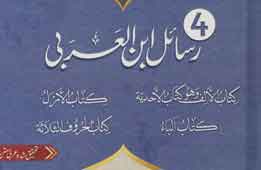
Cover of Rasayl Ibn 'Arabi, translated into Urdu Rasayl Ibn ‘Arabi, Vol. 1, translated into Urdu by Abrar Ahmed, Dar-ut-Tazkeer, 2008. It comprises 12 short works by Ibn ‘Arabi, including the Kitab al-Ahadiyya, the Hilyat al-Abdal, and the Istilahat al-Sufiyya.

The Ibn 'Arabi Foundation, which was responsible for the translation of the Rasa'il Ibn 'Arabi, also announced an Urdu translation of the Tadbirat ilahiya for December 2008. The publishers information quotes Ibn 'Arabi as saying, "This little book contains vast knowledge of great benefit to all. It is gathered from the gardens of Eden and from Divine Providence. It is meant to be a guide to believers There are neither conjectures not doubts in it. Even if some may find faults in it, they will concede that they are small, fine and beautiful."

Cover of Proceedings of the Colloquium held in Damascus Symbolisme et Herméneutique dans la Pensée de Ibn ‘Arabî, Actes du Colloque, ed. Bakri Aladdin, IFPO, Damascus, 2007. Proceedings of the Colloquium held in Damascus, June, 2005. IFPO

Cover of Beshara and Ibn 'Arabi Beshara and Ibn ‘Arabi – A Movement of Sufi Spirituality in the Modern World, by Suha Taji-Farouki, Anqa Publishing, Oxford, 2007. The first detailed analysis of the adoption and adaptation of Ibn ‘Arabi’s heritage by non-Muslims in the West, this work is a study of Beshara and the Beshara School, which emerged in the Britain of the 1970s. Victoria Rowe-Holbrook says, "This important book opens out to provide a much-needed critique of the sociology of Islam in the age of globalization." Michel Chodkiewicz says, "Empathetic in approach and immensely well-documented, this is an exemplary work. Its great importance for Akbarian studies is its discussion of the way in which Ibn ‘Arabi’s teachings have been received and transformed in the modern world."

Cover of Ibn 'Arabî – Time and Cosomology Received December 2007: Ibn 'Arabî – Time and Cosomology by Mohamed Haj Yousef, Routledge, Abingdon, 2008. ISBN 978-0-415-44499-6 (hardback). James Morris says in his introduction to this work: "this book begins with a helpful survey of the standard theories of cosmology and time found in earlier Hellenistic thinkers, which were largely taken over into the succeeding traditions of Islamic philosophy and science. However, the most creative and unfamiliar aspects of Ibn 'Arabi's cosmological ideas – especially his distinctive conception of the ever-renewed, ongoing and instantaneous nature of the cosmic process of creation (tajdîd al-khalq) – are carefully woven together from what have always been profoundly mysterious, problematic, and complexly interwoven symbolic formulations in the Qur'an. Thus the main focus and novel scholarly contribution of the central chapters of this volume lie in the author's careful unfolding and clarification of the intended meanings and references of this dense Qur'anic cosmological symbolism of time and creation, as that multi-dimensional world-view is systematically expounded in elaborate accounts scattered throughout several of Ibn 'Arabi's major works. Every reader who engages with this demanding discussion will come away, at the very least, with a heightened appreciation of the symbolic richness and challenging intellectual dilemmas posed by this unduly neglected – yet areguably quite central and unavoidable – dimension of the Qur'an and its metaphysical teachings."

Cover of Angels Do Not Dream by Rachel Gordin Received September 2007: Angels do not dream, by Rachel Gordin. In Hebrew, published 2007. "The challenges of the 21st century require unity. Global warming, pollution of air and water resources, plagues that don't recognize borders, and exterminations of whole species of animals, are not problems of 'us' and 'them' but of humanity as a whole. According to the sheikh, unity is the most profound certainty, to which are directed all the longings of humanity. Going beyond the peel of 'Arab', 'Israeli', 'Moslem', 'Jew', 'Christian', 'rich', 'poor', 'religious' or 'secular', will expose an unknown entity which has no colour, gender or religion. " This is the third book by Rachel Gordin, formerly film-critic of the Israeli newspaper Ha'aretz. For more information, see rachelgordin.com.